Posts Tagged Rupert Murdoch

Double Standards of Scandalization

What else must happen before one of the world’s most powerful media moguls resigns?

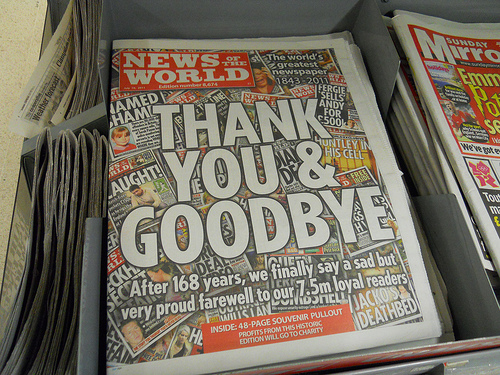
Rupert Murdoch does not hold a public office like Christian Wulff, the former German president, or Philipp Hildebrand, now ex-president of the Swiss National Bank. The question of whether Murdoch is legally responsible for perhaps the largest scandal to engulf the mainstream press in decades remains open.

There is, however, no doubt that he shares a political and moral responsibility for the illegal and systematic tapping of more than 6,000 telephones committed by his journalists. This is no longer a discussion about the work of a singular black sheep, one which could conceivably be found in most large newsrooms. Under Murdoch’s supervision, an undignified corporate culture surfaced, heaving journalism in a new contemptible direction. Rarely has press freedom been abused more blatantly – and thus also endangered, as such criminal energy provokes, of course, counter reactions Read the rest of this entry »

, , , , , , ,

No Comments

The Impossible Balancing Act

Arthur J. Sulzberger

You certainly know Rupert Murdoch, but have you heard of Arthur J. Sulzberger?

Perhaps not, as his name is only well known among media industry insiders. Like many other newspaper publishers, he makes little effort to seek the public limelight. Sulzberger is the publisher of the family-controlled New York Times. In fact, his great, great grandfather was responsible for coining the “All the news that’s fit to print” slogan tucked into the upper left corner of the NYT masthead.

Only a few years ago Murdoch’s News Corp. swallowed the Wall Street Journal, turned it upside down, eliminated a few archaic tendencies and re-launched the paper. At the time, there was much speculation about whether the New York Times would have to deal with a dangerous competitor on its own turf. For a while, the “Grey Lady” – as Americans affectionately refer to the paper – was close to insolvency. Fortunately Mexican investor and TV-magnate Carlos Slim came to the rescue, investing $250 million dollars in the NYT.
Read the rest of this entry »

, , , , , , , ,

No Comments

The “Murdoch of Kabul” and the Cultural Revolution in Afghanistan

After twenty years spent in exile with his family in Australia, Saad Mohseni, son of an Afghan diplomat, returned to Afghanistan as the Taliban regime collapsed in 2002.

 He is now defined by the international media as “The Murdoch of Kabul,” attaining a position among the 100 most influential people in the world, as dictated by Time magazine. Mohseni is the head of a vertically integrated media empire which includes TV channels, a record company, an advertising agency, a television and cinema studio, Afghan Scene magazine and an Internet point network, giving jobs to seven hundred people in Afghanistan and forty in Dubai. Moby Group is the name of the company he founded together with his brothers and sisters. From its offices in the Wazir Akbar Khan district in Kabul, the corporation controls the country’s major media and contributes to the Afghanistan’s  reconstruction in terms of infrastructures and social Read the rest of this entry »

, , , , , , , , , , , , ,

2 Comments

Swan Songs for the Three Tycoons

It was like watching the movie from the day before yesterday.

Suddenly, all the three of them were back: Leo Kirch, Silvio Berlusconi and Rupert Murdoch, the tycoons who influentially roughed up the media business in Europe during the 80s and 90s. We’ve seen obituaries for the first, whose empire had already decayed years ago. As of late, the other two have appeared in headlines due to qualm-less abuses of power, resulting in scandalous news coverage and most probably more than a few sleepless nights upon facing such magnificent losses of power.

The moment these two scoundrels will need to resign draws nearer, and it’s likely their empires will somehow dissipate. Even if Berlusconi’s preference would be to continue his centerstage post at future bunga-bunga parties until the ripe age of 100 in Read the rest of this entry »

, , , , , , , , , , ,

No Comments

English Papers United Against Murdoch

Big Brother is about to step his way into media.

For once, it isn’t Berlusconi.  In fact, according to English papers, the concentration of TV channels belonging to Berlusconi is marginal compared to what is about to occur in Great Britain.  Rupert Murdoch, the Grand Old Man of news, has created a problem so serious it prompted left and right-leaning newspapers to put aside their political and editorial differences and join together in an effort to stop his expansion.

Read the rest of this entry »

, , , , , , , , , , ,

1 Comment

Online Journalism: How to Live Well and Make Money

Adrian Michaels, Group Foreign Editor with the Telegraph Media Group, discusses winning strategies behind the printed press and the Web.

Profitable English daily the Telegraph boasts 40 million readers a month and has a free-access Web site continually investing in conversation and interaction with its readers. In fact, the Telegraph has a highly advanced blog where 40 full-time workers including both journalists and editors contribute. To give just one example, the section devoted to the May 6th general election offers everything: debates with readers, social networks, comments, videos, sophisticated infographics, Read the rest of this entry »

, , , , , , , , , ,

No Comments

Overcoming the Identity Crisis Thanks to Intensified Competition

Neue Zürcher Zeitung, September 26, 2008
How the New York Times renews itself by strengthening its Internet presence
Rupert Murdoch is presently redesigning the Wall Street Journal, thus putting the New York Times under intense pressure. In response, the Times is re-inventing itself at breakneck speed.

Read the rest of this entry »

, , ,

No Comments