Drones Flying Into Newsrooms

May 6, 2012 by · Leave a Comment 

Originally created for military and intelligence purposes, flying drones are becoming an everyday reality thanks to recent commercial success.

For roughly €300, customers can purchase the AR Drone 2.0, a quadricopter capable of shooting high quality video from great heights in the sky. Cameramen and robotics geeks can now buy a user-friendly drone for shooting video or images, making it easy to see the many ways in which flying drones could be used to serve journalistic purposes. Pilots and newsmen can forget having to risk life and limb with helicopter flights, in the future the sky may be full of drone journalists.

The potential of flying drones for journalism has grown from humble beginnings last winter. The movement began when spectacular video surfaced of a Warsaw riot shot by a semi-pro cameraman using a RoboKopter drone. The video went viral on YouTube and showed the event from a unique perspective no other reporter could have captured Read more

Albanian Media and the Local Market

February 16, 2012 by · Leave a Comment 

The changing political system in Albania is tied to the evolution and transformation of the media industry.

The establishment of political pluralism and a market economy in 1991 brought with it the collapse of the state’s monopoly in the Albanian media market. This transition from a centralized system to a private media system was accompanied by fundamental changes in the market. In contrast to the former communist East, where the transition from controlled media markets to free markets occurred in a gradual manner, in Albania this change took place abruptly.

Thus, during the years of 1991-1997, almost all of the newspapers and magazines controlled by the communist state disappeared from circulation (with the exception of the newspaper Zëri i Popullit, the main paper of the communist party in power), and in their place emerged new newspapers which functioned primarily as private businesses. These new media businesses fundamentally transformed the landscape of Albanian media. Before 1990, only two daily national papers were printed: Zëri i Popullit and Bashkimi. In 1991 four daily papers were printed, Read more

Condition ONE

January 27, 2012 by · 1 Comment 

*Article courtesy of the European Journalism Centre

Is immersive storytelling the next big step in conflict reporting?

“If your pictures aren’t good enough, you’re not close enough,” the influential war photographer Robert Capa once said. Now, a new tablet application allows photographers to shoot 180-degree frameless stories straight from the frontlines. “Condition ONE will let people witness a story first-hand like never before,” promises its creator, American photojournalist and filmmaker Danfung Dennis.

Dennis explains that it all started from the frustration of not being able to report the real sense of what he had experienced as a war photographer in Iraq and Afghanistan. “Even though my images and documentary film were published and distributed widely, they were still a passive window into the reality I was witnessing, constrained by the frame,” he says.

Read more

Narrative Science: If Software Replaced Journalist?

November 2, 2011 by · Leave a Comment 

Picture a machine capable of synthesizing sentences and grammatical structures with sophisticated data sequences, writing entire articles simply by following data input.

On paper it might sound rather dystopian –  a particularly Luddite fabrication constructed to warn against the potential evils of technology.

An idea such as this may even bring to mind the plot of one of Roald Dahl’s most famous stories, The Great Automatic Grammatizator, in which a man discovers that grammatical and syntactical structures can be converted into numbers.  The man, Adolf Knipe, uses codes and algorithms to create books and novels, thanks to a complex machine he invented.

On occasion, reality may be stranger than fiction. Narrative Science, a new Chicago-based start-up, born within Northwestern University’s School of Engineering and Journalism, has created software capable of synthesizing different types of data to create editorial content and journalistic articles.  What is more stunning, and possibly even frightening for some journalists, is the quality of the Read more

Killer Technology: Is TV next on the black list?

Before the newspaper industry actually makes it to the media graveyard, experts predict another medium (television) may face the Reaper as well.

In his blog “Reflections of a Newsosaur,” Alan Mutter, a media and technology analyst, asserts that the Internet may pose  a significant threat to television.  High-speed Internet and the new IPTV will soon strangle traditional television as consumers realize they can watch anything  hosted on the Internet directly on home televisions. While this not-yet-so-popular invention is an evident benefit to consumers, managers of local TV stations should be concerned about losing already scarce audiences and the ad revenues that accompany ratings. Mutter warns that if the problem is not addressed now, in five years television will face a crisis similar to one that newspapers encountered five years ago.

Read more at Newsosaur.

Reality TV at the Times

April 12, 2010 by · Leave a Comment 

TimesCast captures newsroom missteps.

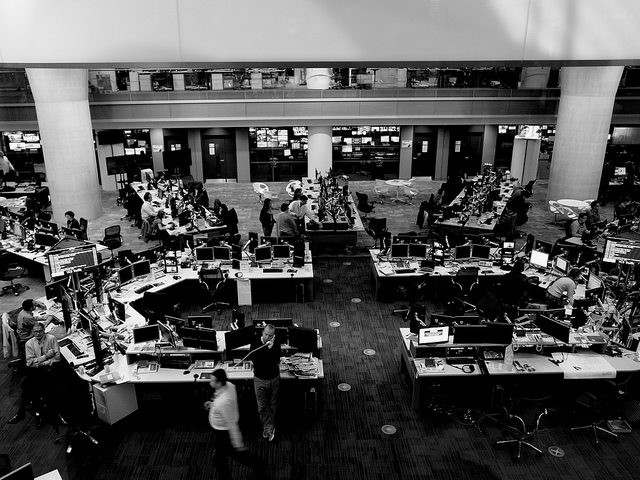
Last month the New York Times launched TimesCast, a daily video produced during morning meetings in the newsroom. The mini program summarizes major stories and includes interviews with the staff, offering readers a peek at the paper’s inner workings. The idea was to jump on the technology train in order to showcase the Times‘ journalism, taking a unique stab at transparency.  As anyone could guess, “uncut” newsroom footage is a stretch from the cool, polished reporting the Times is known best for.  Several recent incidents – heated Tweets, sensitive discourse, fumbled facts – highlight the difficulties in introducing less-forgiving, real-time platforms for newsgathering.

Read more from NYT‘s public editor Clark Hoyt at nytimes.com.

Driving the Death of the Written Word

December 31, 2009 by · Leave a Comment 

A study conducted by Prof. Roger Bohn and Dr. James Short of the University of California at San Diego dispels the notion that visually stimulating forms of media are driving the death of the written word.

Of the 100,500 words they consume each day, Americans read 36 percent. Revealing that reading actually tripled between 1980 and 2008, UCSD researchers suggest the influx of new technologies is actually causing people to read even more than they used to. Concerning the study, Eliot Van Buskirk of Wired writes, “Technology may have truncated and warped the written word in some cases, while increasing competition for our time. But as borne out by this new data, technology hasn’t found a substitute for the written word as a means of conveying certain types of information.”

Read more at Wired.

Next Page »

Bottom