July 17, 2013 •
Specialist Journalism •
by Stephan Russ-Mohl
We are used to the media turning on those who seek to expose corruption and malpractice. But it is shocking nonetheless how soon media companies, when presented with one of the biggest data scandals in world history- namely the news that...
Read article
June 6, 2013 •
Specialist Journalism •
by Kate Nacy
A German web magazine has set up a new kind of forum to discuss the media, and is offering grants for innovative young journalists to discover new ways of reporting. For more than a decade, German publishers have consistently downgraded...
Read article
May 24, 2013 •
Ethics and Quality, Media Economics •
by Stephan Russ-Mohl
Media managers and journalists are not good at dealing with criticism. They demand accountability and transparency from others, but do not see why they should hold themselves up to similar scrutiny. This study argues that the media...
Read article
May 22, 2013 •
Ethics and Quality •
by Susanne Fengler and Tobias Eberwein
The European Union’s proposal to strengthen national media self-regulatory bodies has triggered a new debate on whether or not regulatory institutions carry out their tasks effectively and efficiently. A Europe-wide research project...
Read article
February 4, 2013 •
Ethics and Quality •
by Nadia Leihs
“Can we simply import media accountability instruments from the West?” This is the question raised more than once by journalists and media scientists at the Media Accountably in Transition conferences held in Cairo and Tunis in October...
Read article
December 19, 2012 •
Ethics and Quality •
by Klaus Bichler
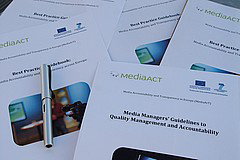
The new Media Accountability and Transparency (MediaAcT) guidebook presents “best practice” examples exhibited by media outlets across Europe, both online and in print. The media industry, particularly in Europe and the US, is in...
Read article
March 29, 2010 •
Ethics and Quality •
by Tina Bettels
Interview with Colin Porlezza, communications researcher at the Università della Svizzera italiana and EJO collaborator. Q: Are there successful examples of media accountability in Switzerland? It depends on what one understands as a...
Read article
March 10, 2010 •
Ethics and Quality •
by Tina Bettels
Daniela Kraus of Medienhaus Wien discusses media accountability, media ethics and innovations in Austrian journalism. Q: Are there successful examples of media accountability in Austria? It would be easier to mention examples that have...
Read article
March 4, 2010 •
Ethics and Quality •
by Tina Bettels
Interview with Heikki Heikkilä, Journalism Research and Development Centre, University of Tampere Q: Are there successful examples of media accountability in Finland? A: Finland is known for its established media accountability systems....
Read article