EU Moves toward
a Digital Freedom Strategy
January 7, 2013 by Philip Di Salvo · 4 Comments
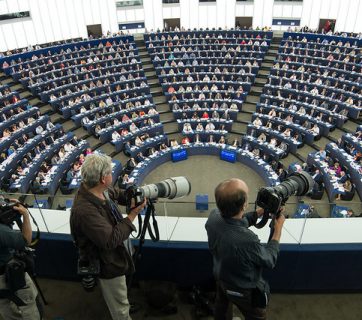
Digital rights deserve just as much protection as the fundamental rights according to the European Parliament in Strasburg, which recently endorsed a report on “Digital Freedom Strategy in Foreign Policy.” The Dutch Member of Parliament, Marietje Schaake – undoubtedly the most “wired” politician in Europe – introduced the report which will hopefully influence future European policy in the field of digital freedom and the Internet. The report, approved in Strasburg with a wide majority, lays out many concrete initiatives which, if formally adopted by the Union, will make Europe one of the most progressive regions for rights in the digital sphere. In fact, the report affirms that “uncensored access to the open Internet, mobile phones and Information and Communication Technologies (ICTs) have impacted human rights and fundamental freedoms, exerting an enabling effect by expanding the scope of freedom of expression, access to information, the right to privacy and freedom of assembly across the world.”
Presentation of the report in the Parliament’s plenary meeting
Greece: Crisis Raises Censorship on the Media
November 9, 2012 by Philip Di Salvo · Leave a Comment
Journalists arrested, netizens remanded to trial. A petition calls on EU authorities to intervene as the media in Athens faces a new season of menace.
Economic crisis is bearing down hard in the Hellenic country. Ongoing violence continues to rattle the capital while the nation remains far from uncovering a definitive solution to its economic woes. Newspapers all over the world reported on recent strikes and anti-austerity protests in Athens as parliament discusses a new €13.5 billion austerity package, yet there’s another matter of concern: freedom of speech. Index On Censorship has denounced “multiple instances of censorship and attacks on the press” and “systematic efforts to curtail media freedom” since the tension began. Kostas Vaxevanis’s story is emblematic of the precarious atmosphere among media outlets in Greece.
Read more
Eight Ways the EU Can Help Journalism
August 24, 2012 by Eric Karstens · 1 Comment
*Article courtesy of the European Journalism Centre
Why is the European Union so ineffective when it comes to supporting press freedom and media pluralism?
The Vice President of the European Commission for the Digital Agenda, Neelie Kroes, addressed this question in a keynote to a European Parliament Seminar on Media Freedom in the EU Member States in May. In short, she made the following points:
- The practical, economic, cultural and legal framework conditions for media pluralism and press freedom vary massively from one Member State to another and thus cannot all be painted with one brush;
- If the EU were to take pluralism-related action at all, it must not focus on bad examples in particular Member States (such as most recently Hungary, or Italy a few years ago), but go for an overarching and universal approach;
- Member States have so far not vested the EU with the power directly to defend media freedom in the first place, at least not within the Member States themselves;
- The issue is aggravated by the fact that journalism, perhaps the most relevant aspect of media pluralism, is currently going through profound changes brought on by the Internet, and the outcome of such changes is yet unknown; Read more
A Pan-European Newspaper
July 12, 2012 by Carmen Paun · Leave a Comment
*Article courtesy of the European Journalism Centre
On a Tuesday morning in Rome, a woman drinks her espresso while browsing the European Daily in a noisy cafeteria.
At the same time in Stockholm, an Erasmus student from Bulgaria is absorbed in a report from the same paper about his country finally being accepted into the Schengen area. Although just a scenario right now, these scenes could soon become reality with the expected launch of the European Daily newspaper in early autumn.
“Europe’s daily newspaper will give open-minded Europeans a reliable, authoritative source for quality news and analysis in English from a European perspective,” says Johan Malmsten, one of the three young founders of the newspaper. Hold on a second, a new daily newspaper in 2012? Who wants to launch a newspaper at a time when advertising revenues are increasingly migrating online and print journalists need to learn multimedia skills to keep their jobs? At a time when media analysts are predicting the death of print media? Read more
The Dark Side of Turkey
June 15, 2012 by Stephan Russ-Mohl · Leave a Comment
There’s been a recent revival of trials attempting to integrate Turkey into the EU, yet advocates of such an action should perhaps take a closer look.
Unfortunately, Western media rarely report on the harassment doled out to members of the press in Turkey. For the sake of transparency, I’ll confess that even as a media researcher and journalism expert, I’ve been largely unaware of how Prime Minister Erdogan has driven the media toward conformity and the ways in which he’s supported the creeping Islamisation of his country. Perhaps most alarming is the recent dismantling of Dogan, the largest Turkish media company to demonstrate a critical attitude toward his government.
Erdogan’s son-in-law was enthroned as CEO of the other media conglomerate, Calik. Unfavorable editors in chief were replaced, and journalists risking a critical lip may face personal reprimands by the prime minister himself Read more
Terror Law Interpretations Shape Future for Turkish Journalists
April 22, 2012 by Michael Wise · Leave a Comment
Journalists in Turkey face increasing harassment and imprisonment due to a handful of loosely interpreted anti-terrorism laws.
As publicity of the intimidation continues, convincing the Turkish government to enact reforms proves to be a delicate task. A new report published early this month by the Organisation for Security and Cooperation in Europe (OSCE) reveals the number of working journalists imprisoned in Turkey has nearly doubled in the past year, bringing the total to 95.
The report, published in conjunction with Reporters Without Borders, details how Turkey has become one of the world’s worst offenders when it comes to jailing journalists. According to the OSCE Representative on Freedom of the Media Dunja Mijatović, the number of imprisoned journalists raises serious questions about the level of free Read more
MEDIADEM Project Moves into Final Year
February 9, 2012 by Michael Wise · 1 Comment
As MEDIADEM authors continue plowing through their research, the scope of the €2.65 million media policy project takes shape.
In a thorough examination, project director Evangelia Psychogiopoulou from the Hellenic Foundation for European and Foreign Policy (ELIMEP) in Athens, Greece, leads a research group intent on determining whether European media policy is fueling or inhibiting a free and independent media system.
MEDIADEM’s objective is to pinpoint and develop media policies that are tailored to the unique fluctuations occurring across the European media landscape. The research project features collaborations from 14 universities in 12 EU countries and two candidate countries and is funded by the European Commission’s 7th Framework Programme for Research as part of the Citizen in the European Union grant agreement. The considerable research undertaking began in April 2010 and will conclude through March 2013. Read more